Plant and Port Facilities
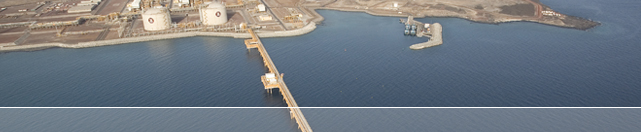
Yemen LNG has constructed the liquefaction plant and port facilities in Balhaf on the coast of Shabwah. The plant and the loading port area are located on a 20 km2 site at Balhaf, situated on the coast of Shabwah, approximately 200 km west of Mukalla and 400 km east of Aden.
Site Selection: Why Balhaf?
The initial screening of the various site alternatives to identify the best LNG plant location took place in 1995. The rationale was to select a combination of LNG plant locations and pipeline routes to transport the gas which would optimise the economics of the project while minimising its environmental and social impacts. The Marib gas field location being fixed, various alternatives were reviewed, and these considered the available options for an access to the sea and a pipeline route through difficult geographical features such as mountains and narrow valleys in areas with a rapid population growth.
In June 1995, a survey of six pre-selected sites was carried out, followed by preliminary comparative studies. Based on these additional surveys and studies, detailed studies were conducted for three sites, Ghubb Diknah, Ras Imran and Balhaf.
This thorough survey and the comparison of the three selected port sites identified Balhaf as the most suitable location for a number of reasons. Minimising the likely impact on the environment and local communities played an important factor in the selection of the final location. Moreover, Balhaf has the lowest geotechnical risk, natural protection and shelter from the waves and winds of the winter monsoon, eliminating the need for a breakwater and a deep harbour, which reduces jetty length, and dredging requirements and which can accommodate large-capacity LNG carriers.
Today, the LNG export facilities in Balhaf are able to accommodate the loading of vessels with capacities ranging from 70,000 m3 to 205,000 m3.

Seri Balhaf, a Yemen LNG carrier at the Yemen LNG Plant in Balhaf
Plant Technology:
Built and operated by Yemen LNG, the plant is based on the proven C3/MR industry standard APCI process and consists of two parallel processing trains with a total guaranteed production capacity of 6.7 million metric tons per year. In addition, two 140,000 m3 storage tanks are being operated as well as ancillary facilities, such as, power generation, desalination, waste water treatment and steam generation, to enable the project to operate on a self-supporting basis in an efficient, reliable and environmentally compliant manner in accordance with applicable international standards.
The proven production capacity of the plant has been reserved to supply sales commitments in the Asian, European and American markets.

Yemen LNG storage tanks, 140,000m3 each
|