First Fish Aggregation Devices Installed in the Balhaf Bay
06 June 2007
On May 23, 2007 Yemen LNG held a ceremony at its Balhaf facility ahead of its launch of the latest in a series of projects aimed at benefiting the communities impacted by the LNG project.
The brief ceremony, conducted by Mr. Faisal Haitham, Yemen LNG’s Deputy General Manager, introduced for the first time in Yemen a device intended to support local fishermen in the area. As its name suggests, the Fish Aggregation Device (FAD) is designed to attract large numbers of fish to gather in specifically designated areas. The ceremony and launch of the FAD were attended by a number of project officials, dignitaries from state and local government, leaders of the fishing communities in the Balhaf area, and representatives from the media.
In his speech, Mr. Haitham introduced the FAD and explained its significance for Yemeni fishermen. He emphasized the importance that the company places on social and environmental responsibility in implementation of the Yemen LNG project. Part of that responsibility, he said, was ensuring that the local communities that have been economically “displaced” by construction of the site were suitably and proactively compensated through a variety of projects. Thus, the FAD, it is hoped, will be a great boon to fishermen, facilitating their work and increasing their catch.
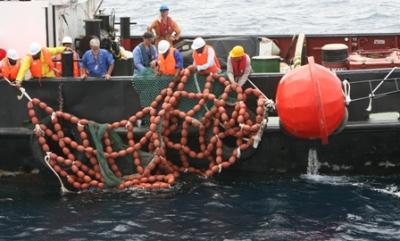
Following the ceremony, the guests embarked on two tugboats and headed some seven kilometers out to sea to the site where the FAD would be situated. The Fish Aggregation Device is essentially a long rope that is extremely thick and strong, attached to buoyant network of other ropes that fan out somewhat to create a larger surface area. The device is anchored to the seafloor by means of a 30-ton cement block. The device that was installed on Wednesday will join two others in the Balhaf area.
The FAD works by creating an artificial ecosystem, essentially mimicking a natural coral reef. Algae will eventually cover the FAD, providing a food source for small crustaceans that will, in turn, attract the small fish that eat them. The smaller fish attract the larger fish that are the target of local fishermen.
As Deputy GM/ Haitham mentioned in his statement during the opening ceremony, Yemen’s near-shore waters are being over-fished and these catches are on the decline. Fish stocks in waters further offshore have not been impacted in the same way, however they are more elusive and fishermen may spend days searching for fish, with no guarantee they will ultimately be successful. It is hoped that the FAD will concentrate offshore fish stock in a small area, guaranteeing the fishermen will have something to show for their labors.
The Fish Aggregation Device is new to Yemen, but has been well tested elsewhere in the Indian Ocean. The island nation of Maldives has installed several hundred FADs, which are considered to be vitally important for the security of livelihoods of the fishermen there. Within three months time we will have a good idea of how successful the FADs are. If this trial follows the trend of other FAD placements, then this could well become an important source of Yemen’s future fish wealth.
The several local communities in the area around Balhaf are relatively small, with generally no more than a few hundred citizens, each. However, all of them derive their livelihoods by fishing local waters. The construction phase of Yemen LNG is running on schedule and is currently more than 50 percent complete, and the massive liquefaction complex at Balhaf has completely transformed the landscape of this section of the Shabwa coast. The LNG plant is situated on a protected natural bay just 30 kilometers west of the major fishing center of Bir Ali. For logistical reasons, the waters immediately surrounding the site are now off-limits to local fishermen, so the installation of the FADs in the area and the benefit they are meant to provide are intend to off set this. The FADs were well received by the community leaders in attendance at the launch, all of whom are eagerly anticipating the devices’ success.
The FADs are part of Yemen LNG’s large-scale program to compensate local communities that have been impacted by either the LNG plant at Balhaf or the 320-kilometer pipeline running from the gas processing facilities at Marib. Guided by the Environmental and Social Management Plan and input from community committees that inform project mangers of the community’s needs, Yemen LNG is funding a comprehensive revamping of fish auctions and provided in both Jela’ah and Bir Ali, access roads to both fish auctions as well as a tractor to haul boats onto shore during the monsoon season, among other projects.
By far the largest compensation project to date is the construction of a multi-million dollar breakwater at Jela’ah, 15 kilometers west of Balhaf. No longer able to use the protective bay at Balhaf, the fishermen need a safe place to keep their boats, especially during the monsoon season. The new breakwater, which will be completed before this year’s monsoon season begins, will provide calm anchorage for fishing boats that would otherwise be lost to the monsoon’s high seas.
These projects, and those to come, are part of Yemen LNG’s commitment to positively impacting the lives of local citizens and minimizing its “footprint,” ensuring that it will ultimately be considered a benefit for all of Yemen.