Statement by General Manager at a Press Conference
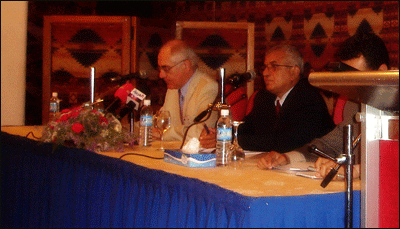
26 July 2006
Good morning ladies and gentlemen,
I am pleased to see this positive turnout of many professional journalists and media representatives.
At first, allow me to confirm that we, in Yemen LNG, are keen to build a strong relationship with the media—one that is based on respect, transparency and mutual cooperation. This is why we called for this press conference, which is intended to become a regular practice in the months to come, with a view to maintaining close communication with the media. The role of media is very important to us both in presenting the major benefits expected to be generated from the project for Yemen and answering concerns and questions that relate to the project. Dialogue with the media directly at the source of information is guaranteeing that no biased or incorrect information will be disseminated.
In my address, I will highlight some key issues:
1) The company’s contribution to Yemen’s economic development;
2) The company’s Yemenisation programme;
3) The progress made so far in the construction of the project;
4) The social and environmental compensation, mitigation and development measures.
1) Contribution to economic development:
** Yemen LNG was launched in August 2005 reflecting the growing international demand for Liquefied Natural Gas (LNG). With its US$ 3.7 billion budget, the project becomes one of the largest investments and the first-ever public-private venture of its kind in the country, of which Yemen is both a partner and a beneficiary.
** In addition, the complexity and modern technology used by the project makes it among only twenty similar projects in the entire world. Upon completion of the construction phase and the commencement of commercial production, the project is expected to generate one of the largest revenues for the country during the period of 20-25 years. Conservative estimates suggest that the Government of Yemen will receive between US$10-20 billion. The project will also contribute to reducing unemployment in the country particularly during the construction phase, and will create several hundred permanent highly-skilled positions for Yemeni citizens throughout the lifespan of the project.
** The Yemen LNG project will also put Yemen on the world’s investment map as a result of which foreign investors may find opportunity to enter Yemeni markets. Opportunities will also be available for national companies both inside and outside of Yemen.
** The marketing strategy of Yemen LNG was to obtain a mix of sales between an Asian contract which provides good stability and security of revenue and US contracts which have more potential upside but less stability. The Asian market was deliberately selected to ensure security of revenues at times when the US gas market price might be depressed. However, the US market is expected to remain an attractive market for Yemen LNG due to high gas demand; which will provide significant additional revenues to Yemen.
Yemen LNG's diversification strategy led to the Company’s signing with KOGAS for 2 million metric tons per annum (mtpa) for the Asian market; with Suez LNG for 2.55 mtpa for the US market; and with Total Gas & Power for 2mtpa also for the US market. All in all, the mix is 70% on the potentially rewarding but volatile US market and 30% on the more stable Korean market. The agreement of Yemen LNG with the Yemeni Government also contains a guarantee of minimum revenues from LNG sales for Yemen. Therefore, even if the prices under the LNG Sales contracts fell below this level, the Government is protected as Yemen LNG will make up the shortfall out of the shareholders share of Company’s profits.
2) Yemenisation Programme and Labour Issues:
** Yemenisation is one integral component of the company’s commitment according to agreements with the Government. The aim is to gradually Yemenise its workforce and build the competencies of Yemeni citizens as they acquire the necessary skills and experience to take over key technical and supervisory roles in the operation of the project.
** In fulfillment of this commitment, Yemen LNG inaugurated in April 2006 a Technical Training Center primarily to provide Yemeni technicians with intensive technician training to operate what will be the most advanced industrial plant ever built in Yemen. Approximately 300 Yemeni technical personnel will pass through this Center. The first batch of 89 trainees have already completed the first milestone of training. A second batch of 45 trainees from the governorates of Marib, Shabwa and Al-Jawf have recently joined the programme, and additional intakes will join later this year and in 2007. All trainees have been selected following a very rigorous testing and recruitment process which involved 16,000 applicants from across Yemen. The training programme covers a mix of English language, theoretical and practical training, as well as hands-on training at Liquefied Natural Gas (LNG) plants around the world.
** The long-term Yemen LNG workforce both at Balhaf and the Head office in Sana’a is expected to reach 600 staff. By and large, Yemen LNG trainees and employees cover a diverse geographical representation from 16 of the 21 Yemeni governorates.
3) Progress:
** Yemen LNG is currently constructing a liquefaction plant in Balhaf on the coast of Shabwah, 200 km south-west of Mukalla, and a 320-kilometer, 38-inch pipeline from the processing centres in Marib to the liquefaction plant at Balhaf (please refer to the information pack that was distributed to you for more information). Proven gas reserves are sufficient to produce and export 6.7 million metric tons a year of LNG for a period of more than 20 years. The construction phase involves building and operating two-train liquefying units for exporting LNG, expandable to three trains in the future.
** The construction of the 320-kilometer pipeline has already begun and is scheduled to be ready by the end of 2007. The Balhaf plant construction is in the site-preparation phase and will be complete and partially operational by the end of 2008, with the second production train operational in the 1st quarter of 2009. But the achievement of the enormous amount of work to meet this production and export date requires an intensive and real cooperation between all concerned stakeholders, including the company, the central and local governments, local organizations and, last but not least, the media
4) Social and Environment Packages:
** A thorough survey of all potential port sites and pipeline routes in Yemen identified Balhaf to be the most suitable location for a balance of technical reasons as well as maintaining a minimal impact on local communities and the environment. The pipeline, for example, mainly passes through deserts and thinly populated areas.
** From the beginning, Yemen LNG realized the likely effects of such a big project on the overall environment and the populations and began in 1997 by conducting a comprehensive Environmental and Social Impact Assessment (ESIA) study which sought to identify concrete measures to avoid or at least mitigate any potential environmental or social effects. I will give you two concrete examples that give you a sense of how we are addressing social and environmental concerns.
** On the social side, Yemen LNG has identified some inevitable impacts on communities, such as the situation lived by fishermen who lost their fishing harbour and safe haven due to the dedication of Balhaf for the purposes of the LNG plant. To address this, Yemen LNG established a committee for the compensation of fishermen, which, in agreement with fishermen associations from the affected regions, reached concrete compensations measures to be undertaken. These measures include:
* Installing a 750-meter breakwater in Jela’ah to substitute for the lost ‘safe haven’ which can accommodate up to 250 fishing boats, which is much more the number of boats that used to benefit from the natural safe haven in Balhaf.
* Installing high-tech aggregation devices around the breakwater and along the shores around Balhaf to help attract fish and facilitate fishing.
* The construction of access roads both in Jela’a and in Bir Ali, and technical mechanisms and computers for better monitoring of auction markets at both Jela’ah and Bir Ali area—a regional fish market about 20 km from Balhaf.
* In addition, we are undertaking several other direct assistance to the different communities along the areas in which we work, including improvements to schools, water development projects, preservation and documentation of archaeological sites, etc.
** Another concrete example relates to the protection of coral reefs in Balhaf.
* As advised by experts, the Yemen LNG plant has undergone modifications from original plans to avoid areas populated by sensitive coral reefs;
* The location of the off-loading facility and harbour was selected to cross less sensitive coral areas;
* The Company has installed in the water silt curtains to ensure that dust and particles resulting from the construction of the harbour do not reach the corals around it;
* Yemen LNG also commissioned the Hadhramout University of Science & Technology to test the turbidity of the water around the harbour on a regular basis, and, on top of all this,
* The Company has commissioned an internationally recognized organization, called CREOCEAN, and an independent reputable coral specialist, to conduct regular surveys for the coral reefs to continually provide feedback on impacts on the corals, if any, thereby advising the company to take action as deemed necessary.
These examples are only two concrete examples that reflect the manner by which we, in Yemen LNG, are dealing with social and environmental issues. Again, I reiterate that we are intending to continue this dialogue with you and are open to your questions and inquiries, both today and in the future. You will find the contact information details of our Public Relations Team in your press kits.
.